
Van Life 102
money, rodents, toilets, food, and parking issues

In late March, I wrote an article titled Van Life 101, in which I offered tips and tricks based on my experiences during the first few months of life on the road. If you missed it, here’s a link to that post:
Now that I’ve stacked up another 2.5 months of experience, I have more to say, especially about money, rodents, toilets, food, and parking issues.
FINANCES
Create a monthly budget. Add 15% to that amount, then throw in another $500. Unless you want to live in a constant state of stress, do not, I repeat, do not launch into van life without a reliable source of income that’s significantly larger than you think you’ll need, as well as a hefty cushion of savings available in an accessible account.
Things break. Essential things. And plans change. The world, heck the entire universe, is fueled by change, so expect it. Be financially prepared. Ask yourself what you’ll do if your van suddenly needs a major repair at the cost of, say, $2,500.

If you’re strategic and well prepared, full-time van life can be less expensive than renting or owning a place to live. But, as with the idea of a tiny house, many people forget one major expense: You’ll need a place to park your home on wheels—a piece of land that includes, at the very least, access to potable water and trash.
In many states, you’ll have options to stay on BLM land for free or for a nominal fee. But most of that land doesn’t include water or trash or showers or restrooms or, sometimes, even a shade tree.
Yes, you can slink around in urban areas, looking for safe neighborhoods or parking lots where you are not likely to be startled awake in the middle of the night by an officer of the law knocking on your door. But that is a stressful way to live.
During the past few months, I’ve paid anywhere from $15 to $52 a night for a campsite—without hookups.
See below for comments about the current state of free nighttime parking in the Western US.
RODENTS
Store anything edible in glass or sturdy plastic containers.
I thought the thick plastic bag containing my rolled oats was impenetrable. Wrong! A mouse (mice?) sniffed it out, chewed through the side of the bag, and feasted happily for a couple of days. Seeing a mouse scamper across the floor of my van and feeling it run up my arms while I was lying in bed…well, you’ll want to avoid that.

You can read about my harrowing mouse adventures here.
MORE ABOUT FOOD
On the road, your shopping list will be different than it was when you had access to a full-size kitchen. Here’s a suggestion: Before you begin van life, spend a week eating like you’re already traveling. Prepare the food and clean up after meals using only what’s available in your van.
For me, that means eating simple crockpot meals (no recipes that require sautéing ingredients before adding them to the pot), sandwiches, salads topped with canned tuna or beans, nuts, fruits, and raw veggies dipped in hummus. There is no stove in Charlotte (my van) or running water. But I have a fridge and lots of electricity.
Instead of cooking meat, I mix pea protein powder with soy milk—37 grams of protein per serving. It earns a zero on the scale of tasting good, but it accomplishes the job of fueling my muscles.
If you’re a meat-and-potatoes person, you should buy a van that includes a basic kitchen. Or choose one of the many options for outdoor cooking: propane stove, campfire, charcoal grill... I didn’t choose any of those because I don’t want to wash cooking pans.
Unless I’m staying in a bonafide campground—one that includes an outdoor sink and hot water (KOA, etc.)—my after-meal cleanup is done by boiling water in my electric kettle and washing dishes in a bucket.
Of course, if you have enough money in your budget, you can eat in restaurants or buy prepared deli food. I rarely do either, for financial and food preferences reasons.
TOILETS
When people find out Charlotte has no plumbing or holding tanks, I can tell that they want to ask potty questions. But they don’t know which words to use. So, after a minute of listening to them stammer—Where do you…um…is there someplace…um…what do you use for…um…—I tell them what they are too verbally constipated (hardy har har) to ask.
I travel with a collapsible, portable toilet. It is stored in one of the van’s bench seats. If I’m staying in a place without restrooms (which includes most BLM land and Boondockers Welcome [see below] locations), I set it up—sometimes in the van, sometimes outside, if a secluded location is available. Eliminations are contained in a disposable bag.
But, so far, I haven’t spent extensive periods of time in places without restrooms. They are everywhere. Because humans need them. Often.
PARKING
Sometimes when I’m on the road I need a place to park Charlotte for a few hours. For lots of reasons. To go for a hike, loiter on a beach, or ride my bike on a long trail. Or maybe I’m just tired of driving and want to lie down and read for a while. I also require stationary time to edit podcasts and write Substack articles.
During daylight hours, finding a space to be is not usually a problem (unless I’m in a really small town). I can hang out in the parking lot of any big box store or mall complex, or next to a city park. I’ve spent countless hours near libraries and grocery stores, and in rest areas.
Before the pandemic, travelers could park their vehicles overnight in many places. In fact, businesses like Wal-mart welcomed RVs. But that has changed. Most rest areas now limit parking to four hours, or don’t allow it at all.
I’ve found that the parking lots of nearly all the large retail stores, including some Wal-mart locations, are now posted with NO OVERNIGHT PARKING signs. The same is true for city parks, churches, beaches, and medical facilities.
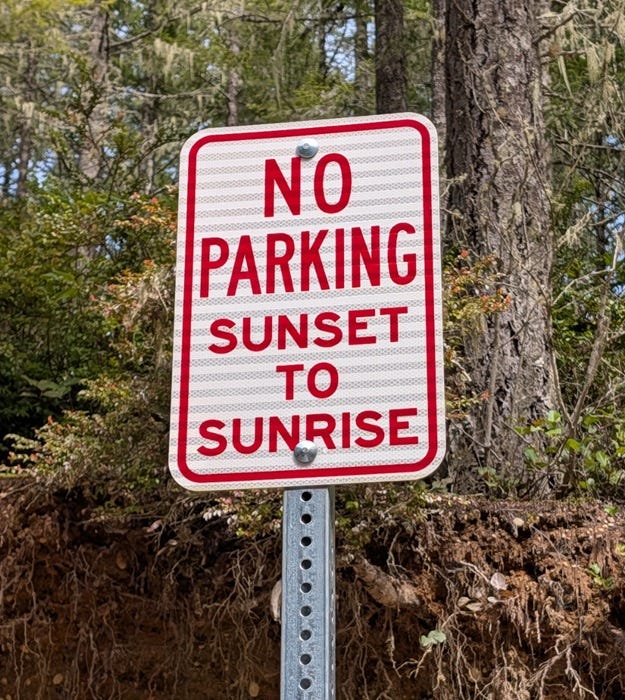
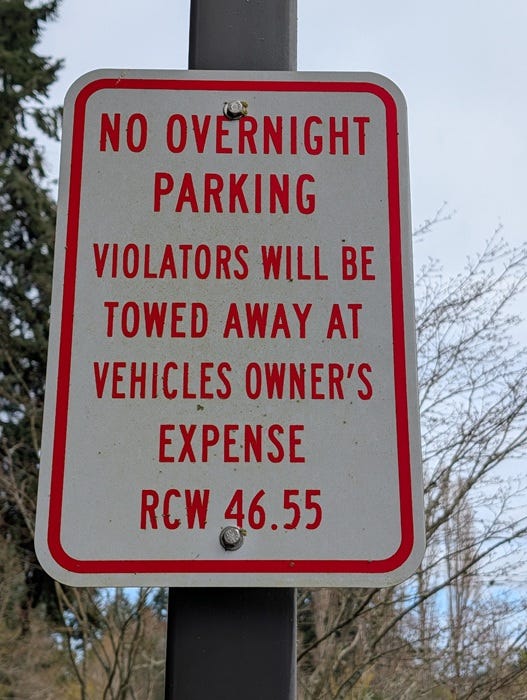
So, what’s a weary traveler, who doesn’t want to pay campground fees just to get a few hours of sleep, to do?
If you are driving along interstate highways, there are still options. But none of the franchise businesses have blanket parking policies, so you must usually stop in or call to ask for permission. Here are a few places that have allowed me to park overnight:
Cracker Barrel (sometimes yes, sometimes no)
Loves Truck Stop (their app includes overnight parking info for each location)
Casinos (hit and miss)
The manager of one Home Depot store said he didn’t care if I parked overnight. But I’ve been denied at other locations.
On secondary roads, free overnight parking is sporadic. I’ve sometimes found helpful information posted in various van life social media groups.
And I have a Boondockers Welcome membership.
For less than $70 a year, their app gives me access to a map showing the locations of hosts all over the US and Canada, people who offer free overnight parking in their driveways or other places on their property. All RVs must be self-contained, unless the host is offering hookups, which most don’t.
Each host offers a description and photos of their parking space, and indicates how many nights a traveler can stay—usually between one and three.
Boondockers Welcome is part of Harvest Hosts, which is another app offering free parking, with stipulations.
OK. That’s it for now. If you have questions about anything you’ve read or other topics, please leave them in the comments.
Happy travels to you!
: )